Fixed Income Risk & Compliance Software
Leave spreadsheets and manual compliance checks behind. Keep every account in line, with guardrails built into the workflow and a complete record behind every decision.
Reduction in pre-trade compliance burden
False-positive compliance alerts, on a system built for fixed income
Increase in portfolios managed per person
See and act on fixed income compliance and risk in a single platform
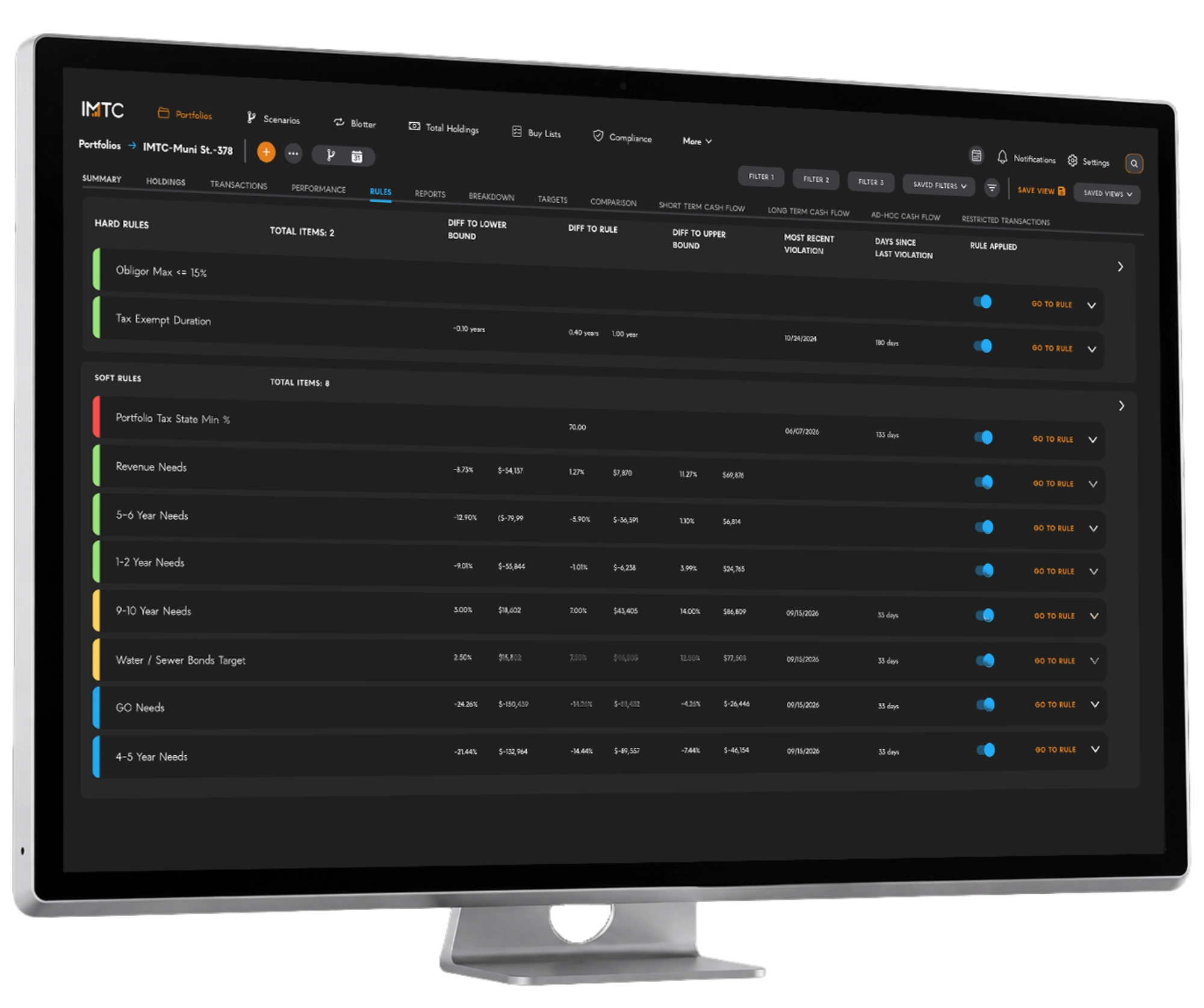
When compliance lives in one person’s spreadsheet or a homegrown model, the process is only as reliable as that person and that file. IMTC institutionalizes it on one AI-enhanced system built for fixed income. Hard, soft, and at-time-of-purchase rules are checked as investment decisions are made, so orders trend toward compliant outcomes instead of getting cleaned up later. Artificial intelligence builds on those same rules and guardrails, helping your team move faster and uncover more while staying inside the framework you’ve already set.

Check compliance in the workflow

Keep accounts aligned to strategy, IPS, and targets

Enforce every client restriction

Meet regulatory and fiduciary obligations

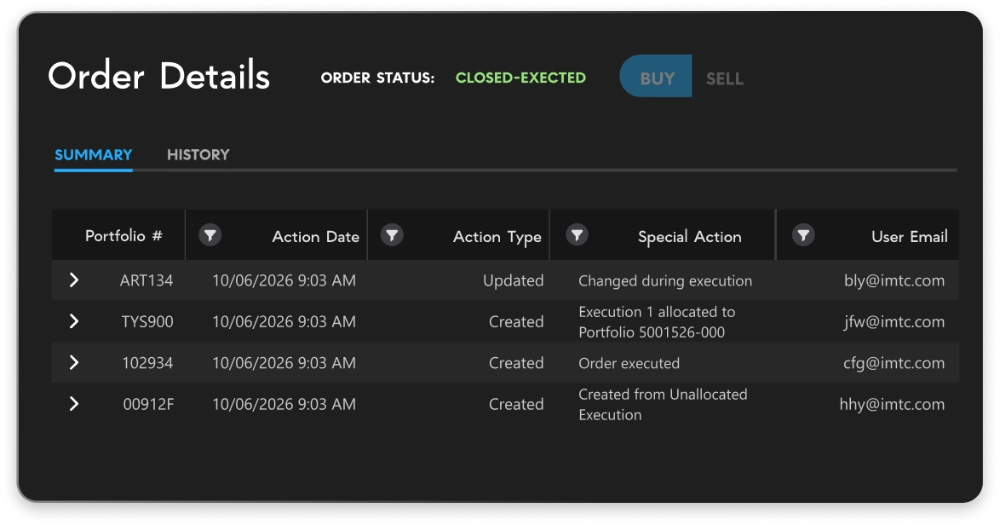
Govern with permissioning and a full audit trail
Keep every account aligned to its strategy
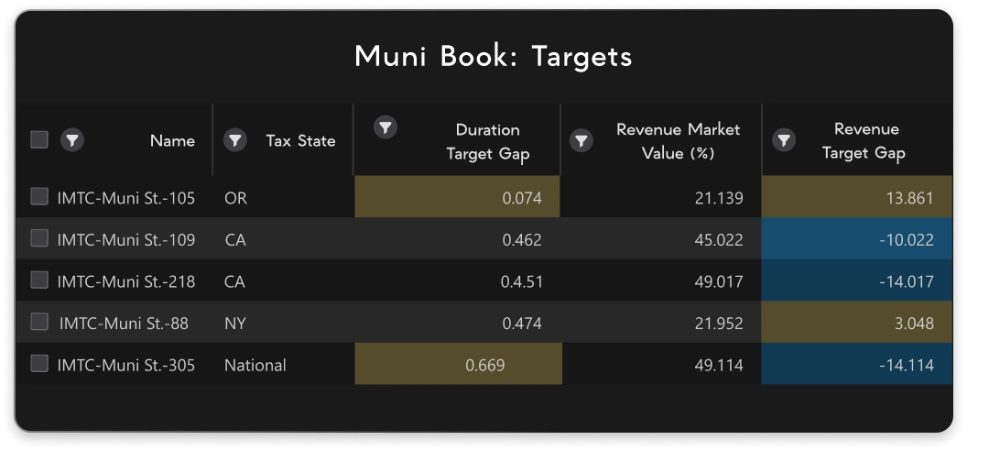
IMTC holds each account to its strategy, IPS, and targets with soft rules, aggregating every account’s distance from target in one view so you can correct drift before it compounds.
- Define targets, guardrails, and ideal portfolio positioning
- Run characteristic-based model strategies
- Catch drift across hundreds of accounts at once
Enforce client and strategy
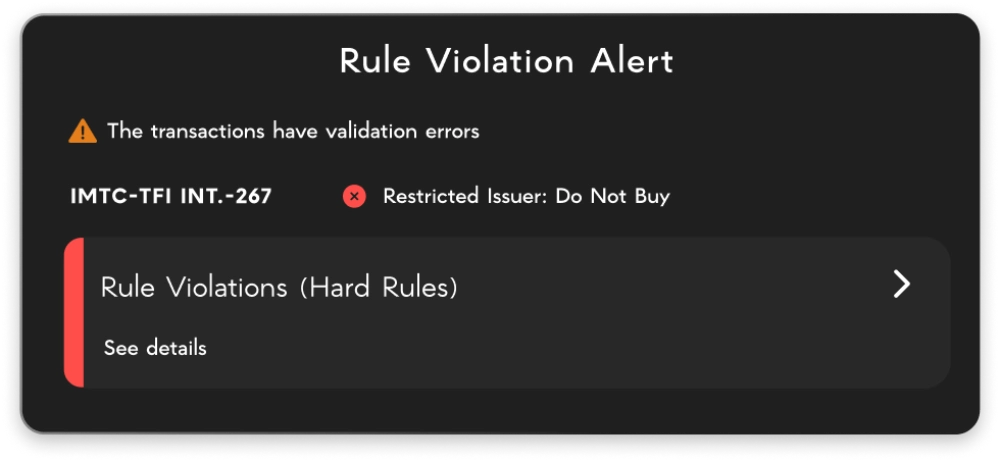
IMTC enforces each account’s personalized restrictions, from prohibited issuers to sector limits and values screens, across hundreds of accounts at once, pre-trade.
- Configure hard, soft, and at-time-of-purchase rules without code
- Apply rules across the entire firm or strategy, or to an individual account
- Define permissions for creating rules, including hard stops to block an order
Meet your regulatory and fiduciary obligations
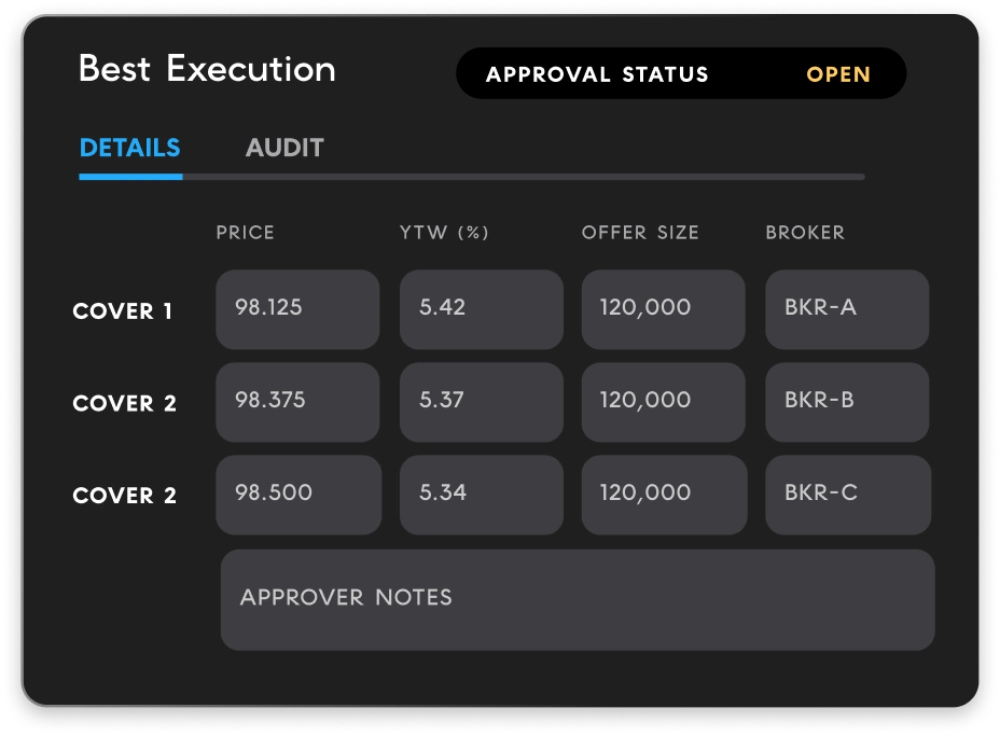
Automated workflows keep you ahead of T+1, support best-execution review, and allocate fairly across accounts, with a clear trail behind every decision for any client, committee, or regulator.
- Stay ahead of T+1 reporting timelines with automated workflows
- Support best-execution review with captured price color and a complete record
- Allocate fairly with rules-based pro-rata and waterfall methodologies
Built-in controls, with a complete audit trail
Construction, optimization, allocation, trading, and compliance all run on IMTC, so one connected audit trail, with rationales, covers the entire lifecycle. Set permissions by role over who can create a rule or override a recommendation, so authority stays where it belongs. The same discipline governs AI, which speeds up the work while keeping every decision in human hands.
- Keep one audit trail across decisions, optimization, allocation, and trades
- Permission every action by role, so control stays where it belongs
- Keep AI-augmented work grounded in approved rules, with people owning every decision
Stay ahead of risk with visibility across your whole book
Your compliance team needs a clear view of risk to do its job. IMTC provides a current snapshot of the whole book in one place, so they see what needs attention without manually pulling data from system to system.

Real-time breach monitoring

Compliance and risk reporting

Interest rate shock analysis

Firm-wide
exposures


FAQ
The best fixed income compliance software is built for the complexities of fixed income, with each account’s rules and targets embedded as guardrails into the workflow so compliance shapes decisions well before an order is placed. It should check rules before and after every trade, monitor active and passive breaches across the book, track drift from targets, aggregate risk at the firm level, and keep a complete audit trail.
Many firms still run this in spreadsheets, manage restrictions one account at a time, or only review compliance after a trade is placed, none of which holds up across hundreds of accounts. Equity-based tools fall short too, requiring workarounds that often generate false-positive alerts. When comparing options, weigh how cleanly each one handles account-level restrictions at scale and whether compliance lives in the same system as construction, trading, and allocation, as it does on IMTC, which is purpose-built for fixed income managers running individual bond accounts and SMAs.
Pre-trade compliance is automated by embedding each strategy’s rules and targets into the workflow and tailoring each individual account’s preferences, so every order is checked against its guidelines before it is placed. IMTC runs those checks inside optimization and allocation, catching orders that would breach a rule while there is still time to adjust them.
For managers running many separately managed accounts, doing this by hand does not scale, since every account carries its own restrictions, targets, and cash. Setting the strategy rules once and tailoring preferences per account applies them across hundreds of accounts at the same time, using hard, soft, and at-time-of-purchase rules to control how each guideline is enforced, inside the same system as construction and trading.
Drift is managed by setting each strategy’s targets once, with any account-level preferences tailored individually, then monitoring every account’s distance from them in one view, so portfolios pulling away from strategy are easy to spot and correct. Fixed income portfolios drift as bonds mature, cash flows in, and markets move, and across hundreds of accounts that drift is hard to see account by account.
IMTC aggregates divergence from targets into a single prioritized list, showing which portfolios are furthest from strategy and why, with soft rules keeping accounts aligned to strategy, IPS, and model targets as the book grows. Since target monitoring shares the same platform as optimization and allocation, bringing an account back in line is part of the same workflow.
Real-time risk monitoring means seeing exposures and compliance status across every account as positions and markets change, rather than waiting for an end-of-day or after-the-fact report. Monitoring one account at a time hides the concentration and drift that only appear when exposures are rolled up across the firm.
IMTC gives fixed income teams that firm-wide picture across issuers, sectors, and accounts, aggregating total holdings and active and passive breaches into one view and letting a team drill from a firm-wide number down to the accounts behind it. For fixed income specifically, that means watching duration, credit quality, and account-level restrictions together, inside the same platform the desk uses to construct and trade.